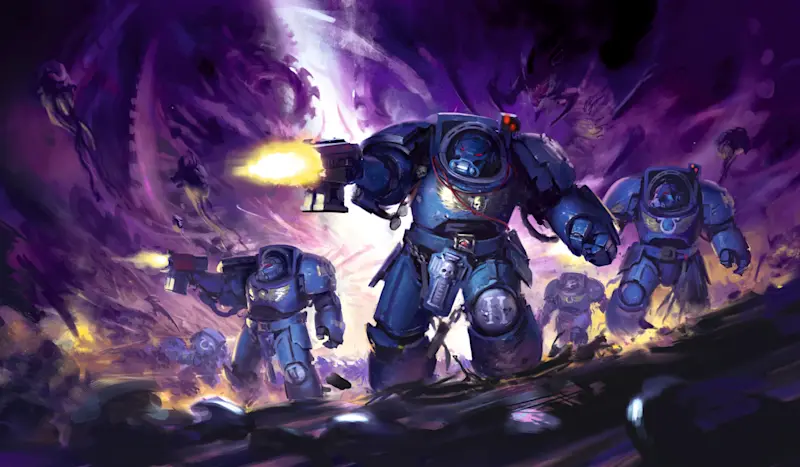
John Blanche, The Artist Who Gave Warhammer Its Soul
When people think about Warhammer, they often think about the miniatures first.
Space Marines clad in towering armour. Orcs charging into battle. Ancient heroes, monstrous creatures, and battlefields stretching across tabletops around the world.

But long before many of those miniatures existed, there was an artist helping to define what those worlds looked and felt like.
His name was John Blanche.
For nearly half a century, Blanche's artwork shaped the imagination of generations of gamers. His paintings, sketches, and visual concepts helped create the identity of Games Workshop's most famous worlds, particularly Warhammer Fantasy Battle and Warhammer 40,000. While many artists contributed to those settings over the years, few left a mark as deep or as lasting as Blanche.
In many ways, Warhammer as we know it today would not exist without him.
A Childhood Filled With Imagination
Born in 1948, John Blanche grew up in post-war Britain. Like many children of the era, he found inspiration in history, adventure stories, toy soldiers, and classic films.
Drawing became an obsession early in life. Blanche has often spoken about sketching warriors and fantastical characters whenever he could. Long before he became a professional artist, he was already creating worlds of his own.
These early influences would remain visible throughout his career. Medieval knights, religious imagery, historical warfare, mythology, science fiction, and horror would all become recurring themes in his work.
Unlike many fantasy artists of his generation, Blanche was never interested in creating perfect heroes. His worlds felt old, worn, and lived in. They were filled with scars, rust, dirt, and mystery.
That approach would eventually help define an entire genre.
Finding His Place in Fantasy Art
Before becoming synonymous with Games Workshop, Blanche worked as a freelance illustrator during the rise of fantasy gaming and speculative fiction in Britain.
His distinctive style quickly stood apart from the more traditional fantasy artwork of the time. While many artists focused on clean lines and idealised heroes, Blanche embraced chaos and atmosphere.
His illustrations appeared on books, game products, and fantasy publications throughout the late 1970s and early 1980s.
It was during this period that his relationship with Games Workshop began.
The Early Days of Games Workshop
In the late 1970s, Games Workshop was still a young company finding its identity.
Blanche contributed artwork to early issues of White Dwarf magazine, producing striking covers that immediately stood out from much of the fantasy art being published at the time.
His work was unusual. Figures appeared weathered and battle-worn. Armour was ornate but practical. Weapons looked ancient and dangerous. The worlds he depicted felt believable because they were imperfect.
As Games Workshop grew, so did Blanche's role within the company.
What started as illustration work gradually evolved into something much larger.
Creating the Look of Warhammer
Perhaps Blanche's greatest achievement was not any single painting.
It was helping create a visual language.
Warhammer Fantasy and Warhammer 40,000 are now recognised across the world, but during their formative years, those settings were still taking shape. Blanche became one of the key figures responsible for deciding what those worlds looked like.
As an artist and later Art Director, he helped guide the visual direction of Games Workshop's growing range of products.
His influence reached far beyond the pages of rulebooks.
Miniature designers drew inspiration from his sketches. Writers built stories around concepts suggested by his artwork. Other artists followed visual themes that Blanche helped establish.
His fingerprints can be found throughout decades of Games Workshop history.
The Birth of Grimdark
If there is one phrase most closely associated with John Blanche, it is "grimdark".
Today, the term is used throughout gaming, literature, and popular culture. It describes worlds that are brutal, oppressive, and morally complex.
Warhammer 40,000 became the defining example of that style.
Much of that atmosphere can be traced directly back to Blanche's work.
His vision of the far future was not sleek and optimistic. It was a universe of decaying empires, religious fanaticism, endless warfare, and ancient technology that nobody truly understood.
Cathedrals floated through space.
Saints marched beside soldiers.
Machines became objects of worship.
Every image suggested a civilisation trapped between glory and collapse.
Modern fans often describe Warhammer 40,000 as gothic science fiction. Much of that identity emerged from Blanche's imagination.
More Than an Artist
Those who worked alongside Blanche often describe him as more than an illustrator.
He was a world-builder.
His role within Games Workshop extended into shaping ideas, inspiring new concepts, and encouraging creativity across multiple departments.
Rather than simply illustrating existing stories, he frequently helped create them.
His sketches were often filled with unusual characters, strange technologies, and fragments of unexplained lore. These details encouraged viewers to imagine stories beyond the frame.
Many hobbyists spent hours studying his artwork, discovering something new each time they looked.
The Rise of Blanchitsu
Few artists can claim to have inspired an entire hobby movement.
John Blanche can.
Over time, hobbyists began using the term "Blanchitsu" to describe painting and modelling styles influenced by his work.
Blanchitsu is less concerned with perfection and more concerned with atmosphere.
Models are often heavily converted. Colours are muted. Equipment appears weathered and used. Characters tell stories through their appearance.
The goal is not necessarily to create the cleanest miniature possible.
The goal is to create something that feels real within its world.
That philosophy continues to influence hobbyists across the globe.
Retirement, But Not an Ending
After more than four decades of involvement with Games Workshop, John Blanche retired from the company in 2023.
For many hobbyists, it felt like the end of an era.
Yet his influence remains impossible to miss.
Every Gothic cathedral on a battlefield. Every inquisitor is draped in relics and parchment. Every rusted tank, battle-scarred warrior, and grim-faced hero carries traces of the visual language he helped create.
His work shaped not only Warhammer but the wider tabletop gaming hobby.
Few artists can claim to have influenced the appearance of an entire fictional universe.
Fewer still can claim to have influenced multiple generations of gamers.
John Blanche achieved both.
A Lasting Legacy
The history of tabletop gaming is filled with talented designers, writers, sculptors, and artists.
John Blanche stands among the most important of them.
His paintings helped transform collections of rules and miniatures into living worlds. His imagination gave those worlds personality, atmosphere, and identity.
For many players, painters, and collectors, Warhammer was never just a game.
It was a universe.
And for nearly fifty years, John Blanche helped us see it.